Table of Contents
ToggleA blank wall in the living room is like a builder-grade door slab waiting for paint, it gets the job done, but it doesn’t say much. Large modern wall art changes that. It anchors the room, creates a focal point, and sets the tone for everything else. Whether hanging a five-foot canvas or installing a multi-panel piece, the right art can make a space feel finished and intentional. This guide covers scale, style, placement, and budget options to help anyone tackle this project with confidence.
Key Takeaways
- Large modern wall art anchors your living room by creating a focal point and visual weight that balances furniture and architectural features while making spaces feel intentional and finished.
- The ideal size for large modern wall art should cover two-thirds to three-quarters of the furniture width beneath it, with the center positioned at 57 to 60 inches from the floor at eye level.
- Abstract and geometric designs are the most popular modern art styles, offering versatility and clean lines that pair seamlessly with minimalist furniture and contemporary interiors.
- Proper installation of large wall art requires wall anchors rated for weight, a stud finder to locate support, and a 4-foot level for accurate placement—never measure down from the ceiling.
- Budget-friendly alternatives like giclée canvas prints ($100–$400), DIY painted canvases ($60–$100), and textile wall hangings deliver gallery-quality impact without the $500–$5,000+ cost of original artwork.
Why Large Modern Wall Art Makes a Dramatic Impact
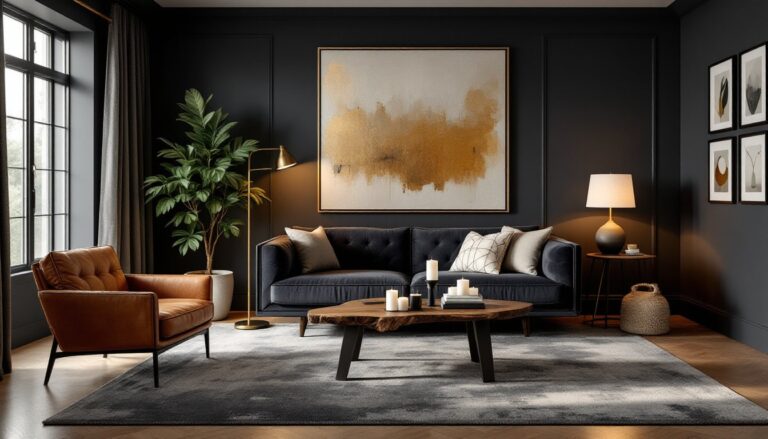
Large-scale art does heavy lifting in interior design. It commands attention the moment someone walks into a room and creates visual weight that balances furniture, windows, and architectural features. In open-concept homes, a single oversized piece can define the living area without adding walls or dividers.
From a practical standpoint, one large artwork simplifies decision-making. Instead of arranging a gallery wall with multiple frames, hooks, and alignment headaches, mounting one statement piece requires fewer fasteners and less measuring. It also makes the ceiling feel higher, vertical pieces draw the eye upward, while wide horizontal works emphasize room width.
Modern art suits contemporary and transitional spaces particularly well. Clean lines, bold colors, and abstract forms complement minimalist furniture, neutral palettes, and natural materials like wood and metal. Even in rooms with eclectic or traditional elements, a carefully chosen modern piece can serve as a bridge between old and new.
Choosing the Right Size and Scale for Your Living Room
Size matters more than style when selecting wall art. A piece that’s too small disappears: one that’s too large overwhelms. The general rule: art should cover two-thirds to three-quarters of the furniture width beneath it. For a standard 84-inch sofa, aim for artwork between 56 and 63 inches wide.
Measure wall height next. In rooms with 8-foot ceilings (standard in most homes), leave 6 to 12 inches between the top of the sofa and the bottom of the artwork. The center of the piece should sit at 57 to 60 inches from the floor, roughly eye level for most adults. In rooms with taller ceilings, scale up proportionally but maintain the eye-level guideline.
For walls without furniture below, focus on the wall’s total dimensions. A piece that occupies 50 to 75 percent of the available wall space feels balanced. In small living rooms with limited wall real estate, one large piece often works better than multiple small ones, which can make tight spaces feel cluttered.
Don’t forget depth. Canvas wraps and framed pieces add 1.5 to 3 inches of projection from the wall. In narrow walkways or behind seating areas, choose slimmer profiles to avoid head bumps and tight clearances.
Popular Modern Art Styles for Contemporary Living Spaces
Modern art spans dozens of substyles, but a few dominate residential installations. Understanding the differences helps narrow choices and match artwork to existing decor.
Abstract and Geometric Designs
Abstract art uses color, shape, and texture without representing specific objects. It’s versatile, bold pieces energize neutral rooms, while softer abstracts add visual interest without competing with patterned furniture. Look for works with movement or layering to create depth.
Geometric designs feature clean lines, symmetry, and repeating patterns. They pair well with mid-century modern furniture, industrial accents, and Scandinavian interiors. Many geometric pieces use limited color palettes, blacks, whites, grays, and one or two accent tones, which makes them easy to coordinate with existing wall colors.
According to design experts at Elle Decor, large-scale geometric prints work particularly well in open-plan spaces where repetition and structure help define zones without adding physical barriers.
Minimalist and Monochromatic Pieces
Minimalist art strips everything down to essentials, often a single brushstroke, color block, or subtle gradient. These pieces excel in rooms that already have visual complexity from textured fabrics, wood grain, or architectural details. They provide a resting place for the eye.
Monochromatic works use variations of one color or stick to black, white, and gray. They’re forgiving if paint colors or furniture change later, and they photograph well, a bonus for anyone who shares home photos. Textured monochromatic pieces (like heavy impasto or mixed media) add dimension without introducing new hues.
This approach aligns with trends seen on Design Milk, where restraint and intentionality define contemporary interiors. Less really can be more when the scale is right.
How to Position and Hang Large Wall Art Like a Pro
Hanging oversized art isn’t just about driving a nail. Weight, wall type, and leveling all matter. Most canvas pieces over 30 × 40 inches weigh 10 to 25 pounds: framed works can hit 40+ pounds. Standard picture hangers won’t cut it.
For drywall: Use wall anchors rated for the artwork’s weight. Toggle bolts or molly bolts distribute load across a larger area and prevent pullout. If possible, locate wall studs with a stud finder and anchor directly into them using 2.5- to 3-inch wood screws. Studs are typically spaced 16 inches on center in most residential construction.
For plaster or lath walls: Pre-drill pilot holes to prevent cracking. Use screw-in anchors designed for plaster, not drywall anchors, which can crumble old plaster.
Leveling: A 4-foot level works better than a small torpedo level for large pieces. Mark the desired center point, measure up from the floor (not down from the ceiling, which may not be level), and use painter’s tape to outline the artwork’s footprint before committing to holes.
Hang art so the bottom edge sits 6 to 12 inches above furniture. For standalone walls without furniture, maintain the 57- to 60-inch center height rule. In rooms inspired by modern farmhouse aesthetics, slightly lower placements can emphasize coziness, but don’t drop below 54 inches or the piece will feel like it’s sliding off the wall.
Safety note: Wear safety glasses when drilling overhead, and use a dust mask if working with plaster. Have a second person support large pieces during installation, awkward angles and heavy frames lead to dropped art and damaged walls.
Budget-Friendly Options and DIY Alternatives
Original large-scale art can run $500 to $5,000+, but plenty of alternatives deliver impact without the price tag. High-quality prints, DIY builds, and unconventional materials make statement walls accessible.
Prints and reproductions: Giclée prints on canvas offer gallery-quality reproduction at a fraction of original artwork costs. Expect to pay $100 to $400 for a 40 × 60-inch stretched canvas print, depending on the artist and vendor. Many online print services allow custom sizing, so fitting exact dimensions is straightforward.
DIY painted canvas: Buy pre-stretched canvas panels (a 36 × 48-inch panel costs around $30 to $50) and acrylic paints. Abstract and geometric styles are beginner-friendly, no drawing skills required. Use painter’s tape to create clean lines and color blocks. Two coats of paint and a matte sealer finish the job. Total cost: $60 to $100.
Textile and fiber art: Large woven wall hangings, macramé pieces, and fabric tapestries add texture and warmth. These work especially well in rooms with lots of hard surfaces. Mount them on wooden dowels or curtain rods for a clean look. As noted by interior designers at MyDomaine, layering textures, fabric art with leather seating or metal accents, creates visual richness in contemporary spaces.
Salvaged materials: Reclaimed wood, metal panels, and composite boards can become statement art. A grid of 1 × 6 pine boards stained in varying tones, mounted to a plywood backer, creates a rustic-modern look. Sand edges smooth and seal with polyurethane to prevent splinters. This approach suits rooms with coordinated furniture sets that need a handmade accent to break up mass-produced uniformity.
Framing costs: If ordering prints, consider frameless hanging systems or DIY frames built from 1 × 2 lumber and mitered corners. Pre-made frames for oversized art often cost $200+, but materials for a simple frame run $40 to $80. A miter saw gives clean 45-degree cuts: a hand miter box and saw works for those without power tools, though cuts take longer.
Budget qualifier: Costs vary by region and material availability. Lumber prices fluctuate, and shipping for large canvases can add $50 to $150 depending on distance. Shop local art fairs, estate sales, and online marketplaces for original pieces at lower price points.