Table of Contents
ToggleAn accent chair isn’t just extra seating, it’s the piece that pulls a room together, adds visual weight to an empty corner, and gives guests a reason to compliment your taste. In 2026, modern accent chairs have evolved beyond simple function. They’re sculptural, versatile, and built to anchor a living room’s aesthetic while still being comfortable enough for daily use. Whether someone’s working with a compact space or a sprawling open-plan layout, the right chair can make the difference between a room that feels finished and one that falls flat.
Key Takeaways
- Modern accent chairs pull a living room together by adding visual weight, personality, and functional seating without the commitment of a full furniture overhaul.
- Mid-century modern and Scandinavian minimalist designs dominate 2026 trends, with mid-century chairs featuring tapered legs and organic curves, while Scandinavian styles prioritize light woods and minimal padding.
- Proper measurements and proportions are critical: choose a chair 28-30 inches wide for tight spaces, maintain similar seat heights with the sofa, and ensure 30-36 inches of clearance for comfortable movement.
- Quality accent chairs feature hardwood frames with mortise-and-tenon joinery, high-density foam cushions (at least 1.8 lbs per cubic foot), and removable upholstery for long-lasting durability.
- Strategic placement transforms accent chairs from simple furniture into focal points—angle them toward the sofa, pair with side tables and lamps, and use them to define zones and balance visual weight in open-plan layouts.
- Upholstery choice should either complement or contrast with existing textiles, with performance fabrics and stain-resistant finishes ideal for households with kids or pets.
Why Modern Accent Chairs Are Essential for Your Living Room
Modern accent chairs solve practical problems while adding personality. They break up the monotony of matching furniture sets, introduce texture and color, and create functional zones within a room. A well-placed chair can define a reading nook, balance a sectional sofa, or provide a visual endpoint to a conversation area.
From a design standpoint, these chairs offer flexibility that sofas can’t match. They’re easier to move, reupholster, or swap out when tastes change. Unlike a couch, which typically anchors a room for years, accent chairs let homeowners experiment with bold patterns, unexpected materials, or statement silhouettes without committing to a full furniture overhaul.
Functionally, they’re workhorses. An accent chair fills the gap when the sofa’s full, serves as a perch for folding laundry, and provides a landing spot for bags and coats in high-traffic homes. In small living rooms, a single well-chosen chair can add seating without the footprint of a loveseat.
Modern designs prioritize clean lines, quality materials, and thoughtful proportions. They’re built to last, solid hardwood frames, mortise-and-tenon joinery, and high-density foam cushions are standard in quality pieces. This isn’t disposable furniture: it’s an investment in how a space functions and feels.
Top Modern Accent Chair Styles to Consider
Choosing the right style depends on the room’s existing architecture, the homeowner’s lifestyle, and how much visual weight the space can handle. Here are two dominant trends that continue to define modern interiors.
Mid-Century Modern Chairs
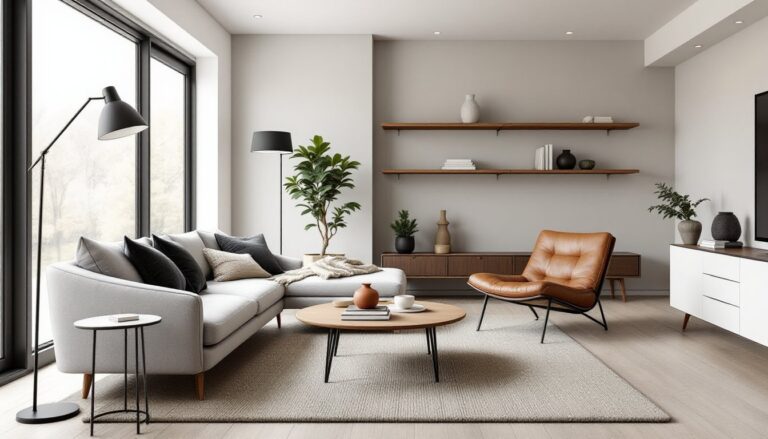
Mid-century modern chairs remain a staple for good reason. Characterized by tapered legs, organic curves, and exposed wood frames, they blend seamlessly into both vintage and contemporary settings. Look for chairs with walnut or teak legs, sculpted plywood backs, and upholstery in wool blends or leather.
The geometry matters. Chairs with angled backrests (typically 15-20 degrees from vertical) offer better lumbar support than upright designs. Seat depth usually runs 18-20 inches, deep enough for comfort but shallow enough to maintain the streamlined silhouette. These proportions work well in rooms with 8-foot ceilings or lower, where oversized furniture can feel oppressive.
Mid-century pieces pair naturally with modern farmhouse living spaces, where the wood tones complement reclaimed beams and shiplap. They also anchor elegant living rooms when upholstered in velvet or bouclé.
Platforms like Design Milk frequently showcase reissues of classic mid-century designs alongside contemporary interpretations. When shopping, check that the frame uses hardwood (not particleboard) and that cushions are removable for cleaning.
Scandinavian Minimalist Designs
Scandinavian chairs strip away ornamentation in favor of function and form. Expect light woods (ash, birch, beech), slim profiles, and neutral upholstery. The aesthetic is airy, ideal for spaces that need seating without visual clutter.
These designs often feature exposed frames with minimal padding. Seat heights typically sit at 17-18 inches, which works well for conversation areas where eye level should stay consistent across seating types. The lack of bulk makes them easy to tuck into corners or slide under consoles when not in use.
Scandinavian minimalism thrives in coastal living rooms, where light wood tones echo driftwood and weathered decking. The style also complements monochromatic or neutral palettes, letting architectural details, crown molding, wainscoting, large windows, take center stage.
Fabric choices lean toward linen, cotton canvas, and performance textiles with stain resistance. Avoid over-stuffed cushions: the aesthetic calls for firm, tailored upholstery that maintains clean lines. Resources like Dwell often feature Scandinavian-inspired interiors that demonstrate how restraint in furniture choice can amplify a room’s proportions.
How to Choose the Perfect Accent Chair for Your Space
Start with measurements. An accent chair should be proportional to the room and the other furniture. Measure the available floor space, accounting for 30-36 inches of clearance around the chair for comfortable movement. In tight quarters, a chair with a smaller footprint, around 28-30 inches wide, prevents the room from feeling cramped.
Next, consider scale relative to the sofa. If the sofa has a low profile (seat height around 17 inches), choose a chair with a similar seat height to maintain visual continuity. Mixing heights can work, pairing a low sofa with a taller wingback chair, for example, but it requires intentional balancing with rugs, side tables, or lighting.
Upholstery should either complement or contrast with existing textiles. In a room dominated by solid colors, a patterned chair adds interest without requiring a full redesign. Conversely, if the sofa already features bold prints, a solid chair in a coordinating hue grounds the space. When evaluating color schemes for living rooms, remember that accent chairs are an opportunity to introduce a tertiary color that ties together disparate elements.
Frame material matters for longevity. Hardwood frames, oak, maple, or rubberwood, withstand years of use. Avoid chairs with MDF or plywood frames unless they’re reinforced with corner blocks and metal brackets. Lift the chair: quality pieces feel solid, not hollow.
Cushion construction affects both comfort and durability. High-density foam (at least 1.8 lbs per cubic foot) resists sagging. Down-filled cushions offer a softer sink but require regular fluffing. For households with kids or pets, look for removable, washable covers or performance fabrics treated with stain-resistant finishes like Crypton or Sunbrella.
Test the chair if possible. Sit with your back against the backrest: your feet should rest flat on the floor without the seat edge digging into the back of your knees. Armrests should allow your shoulders to relax, if they’re too high, you’ll hunch: too low, and they’re useless.
Finally, think about versatility. A chair that works only in one spot is a liability if the room gets rearranged. Swivel bases, lightweight frames, and neutral tones increase a chair’s adaptability across different layouts and design phases.
Placement Tips That Maximize Impact
Placement determines whether a chair becomes a focal point or fades into the background. Start by identifying dead zones, corners, alcoves, or spaces between windows that lack purpose. An accent chair transforms these areas into intentional design moments.
Angle the chair slightly (around 15-30 degrees) toward the sofa to encourage conversation. A chair placed perfectly parallel to a wall can feel stiff and uninviting. The subtle angle softens the geometry and makes the seating arrangement feel more organic.
Pair the chair with a side table or floor lamp to create a complete vignette. The table should be within arm’s reach, about 24-26 inches from the seat, so it’s functional for setting down a drink or book. A lamp adds task lighting and vertical interest, especially in rooms with limited overhead lighting.
In open-plan layouts, use an accent chair to define zones. Positioning a chair with its back to the dining area, for example, visually separates the living space without requiring a physical divider. This technique works particularly well in cozy living rooms where creating intimacy within a larger footprint is key.
Balance is critical. If a room already has a sofa and loveseat on one side, an accent chair on the opposite side prevents the space from feeling lopsided. Use rugs to anchor furniture groupings: a chair placed partly on and partly off a rug looks unintentional. Ideally, the front legs should rest on the rug while the back legs sit on the floor, or the entire chair should be on the rug.
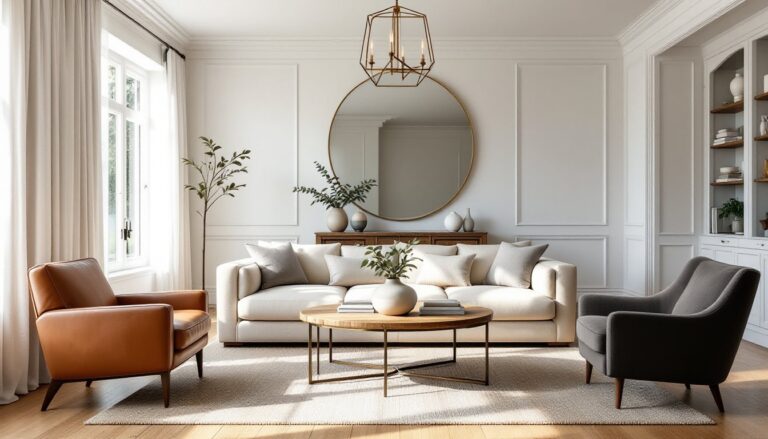
For symmetrical layouts, common in formal living rooms, flank a fireplace or console table with matching chairs. This approach works in elegant living rooms where balance and proportion reinforce a sense of order. For asymmetrical, more casual spaces, mix and match chairs with different silhouettes but cohesive colors or materials.
Windows present an opportunity. Placing a chair near a window creates a natural reading nook, but avoid blocking too much light. If the chair backs up to a window, keep the backrest low (under 32 inches) to preserve sightlines. Inspiration galleries on Homify frequently showcase window-adjacent chair placements that maximize both light and function.
Finally, consider traffic flow. Chairs shouldn’t obstruct main pathways. Leave at least 36 inches between the chair and high-traffic routes, hallways, doorways, or the path to the kitchen. In tight spaces, opt for armless or low-arm designs that take up less lateral space.
Conclusion
A modern accent chair is more than a design flourish, it’s a functional anchor that shapes how a room is used and experienced. The right piece balances proportion, material quality, and placement to deliver both comfort and visual impact. Take the time to measure, test, and plan, and the result will be a living room that feels intentional, cohesive, and ready for whatever 2026 throws at it.